We've already talked about what ‘pay small small’ means and where it shows up in formal finance - installments, BNPL, layaway, ajo and susu, even mortgages. If you haven't read that blog, it's worth a quick look first.
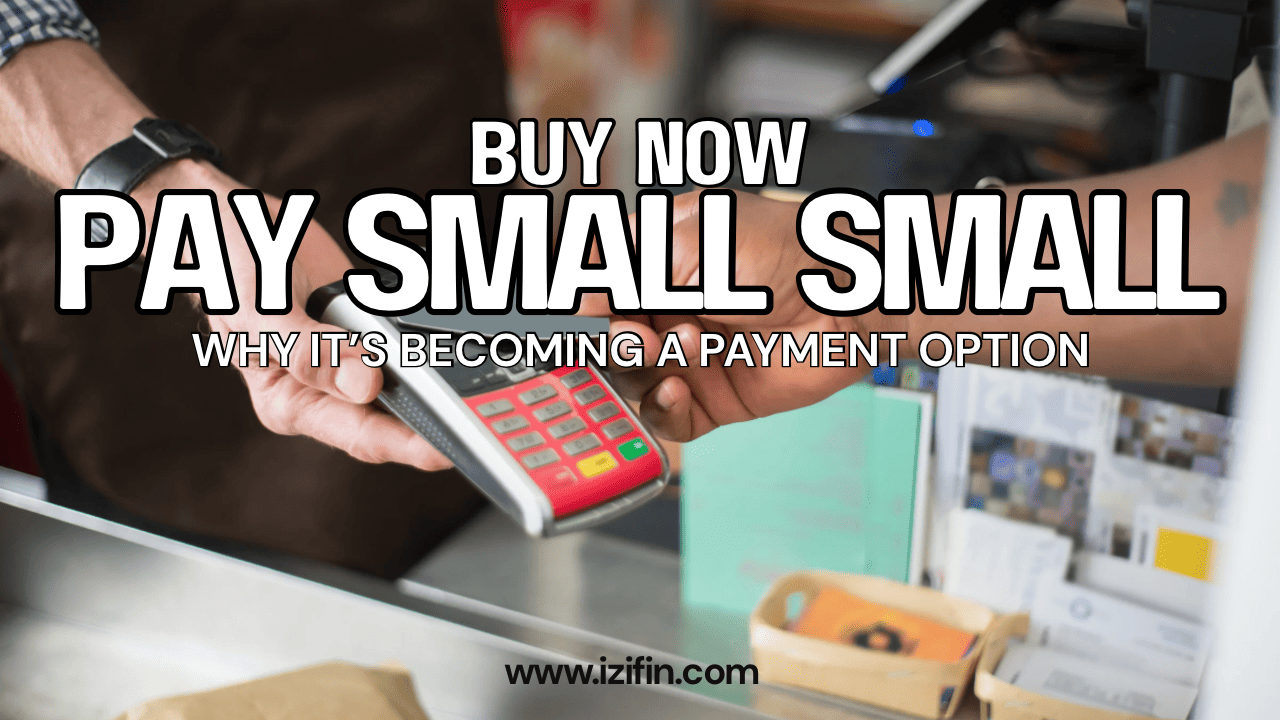
This post picks up where that left off, and asks a more practical question. Why is Buy Now, Pay Small Small suddenly everywhere in Nigerian commerce, and what does that mean for the way we shop, run businesses, and think about money?
From Market Trade to Mainstream: The Rise of Buy and Pay Small Small#
For a long time, Pay Small Small lived mostly in informal spaces, a market trader, a landlord, a friend settling a debt in bits. It was personal, relationship-based, and largely invisible to formal business.
That's changed, what used to be a favor between a trusted trader and a regular customer has become a built-in feature at checkout, on hospital payment desks, in travel and tourism, and gadget shops.
Why Buy and Pay Small Small Is Growing in Nigeria Right Now#
A few things are converging right now to push Buy Now, Pay Small Small from niche to mainstream.
The cost of everyday essentials has climbed faster than incomes in a lot of households, which means even people with steady income increasingly need to spread out large purchases, not because they can't afford them, but because affording them all at once has become harder.
At the same time, Nigerians have grown far more comfortable transacting digitally, mobile banking, fintech apps, and instant transfers have normalized the idea of managing money through an app, which makes instalment-based buying feel far less foreign than it might have a decade ago.
Businesses are noticing something too, a customer walking away from a purchase isn't always a lost sale because of price. Often, it's a lost sale because of timing. That distinction has quietly pushed more businesses to ask a different question, not ‘can this customer afford it,’ but ‘can I make this easier for them to pay for.’
Buy Now, Pay Small Small for Businesses#
This is no longer theoretical, it's already reshaping how real businesses operate.
At Cedarcrest Hospitals, an instalment payment plan meant a family could focus on a loved one's recovery instead of scrambling to cover a hospital bill all at once. A patient's daughter described the experience as ‘seamless and stress-free,’ which is a very different emotional outcome than the panic a sudden medical bill usually brings.
Pascussi uses this same kind of infrastructure to let customers buy now and settle the cost gradually, turning what might have been a hesitant browser into a confirmed sale.
These examples point to something bigger than convenience. They show Pay Small Small moving into spaces where money and stress are most tightly linked, healthcare, essential retail, etc.
What Buyers Should Know Before Using Pay Small Small#
If you've noticed more businesses offering this option lately, it's not a coincidence, and it's worth knowing how to use it well.
The other day whilst booking a flight, I saw Pay Small Small as a payment option on Wakanow.
The offer of Pay Small Small doesn't remove the responsibility to check the full cost of the arrangement, including any fees or interest attached to it. It also doesn't remove the need to be honest with yourself about whether the repayment schedule fits your actual income, not just your immediate want. Used with that awareness, it's a genuinely useful tool, one that lets you access what you need now, without pretending a large upfront cost isn't a real constraint.
What Businesses Should Know Before Offering Pay Small Small#
For businesses, the growth of Buy Now, Pay Small Small isn't just a payment trend to watch from the sidelines, it's becoming a competitive factor. Customers are increasingly comparing not just your prices, but your payment flexibility, against other businesses offering the same product or service.
The businesses adapting well aren't necessarily the biggest ones. They're the ones treating this shift as a genuine customer need, not a gimmick, choosing payment infrastructure that's simple to apply for, transparent about terms, and built with an understanding of how Nigerians actually manage money, rather than a generic model borrowed from elsewhere.
Buy Now, Pay Small Small has moved from a favor between a trader and a trusted customer to a real, functioning layer of Nigerian commerce, one showing up in hospitals, retail counters, and checkout pages alike. The businesses that understand this shift early are the ones building real trust with customers who are simply asking for a little more room to manage their money on their own terms.
If you're a business owner, ask yourself honestly, are you making it easy for your customers to say yes to you, even when they can't pay in full today?
Talk to our team 09163749161 to see how Buy Now, Pay Small Small infrastructure can work for your business.
About the Author
Eniola Apesinola
Contributing writer at the IziFin team. Exploring the frontiers of data engineering, automated finance, and financial inclusion.